
Internal build · Case Study
The Business That Runs Its Own Morning
The problem
This one is mine. Running a one-person consultancy meant four channels, no shared memory, and a decision every morning about what mattered. Upwork, cold email, LinkedIn, and the calendar each held one piece of the picture and none of them held the whole thing.
Nothing ever failed loudly. A drafted reply would sit unsent for five days. A follow-up sequence would stop firing and look exactly like a quiet inbox. A held call would go three days without an offer. Every one of those cost more than any missing lead did.
Who this is for
Owners who are the whole operation. If the pipeline lives in your head, if you start each morning re-deciding what to work on, and if the only reason things get done is that you remembered them, this is the shape of the fix.
Worth building once the number of open conversations passes what one person can hold. Before that, a notebook wins.
What I built
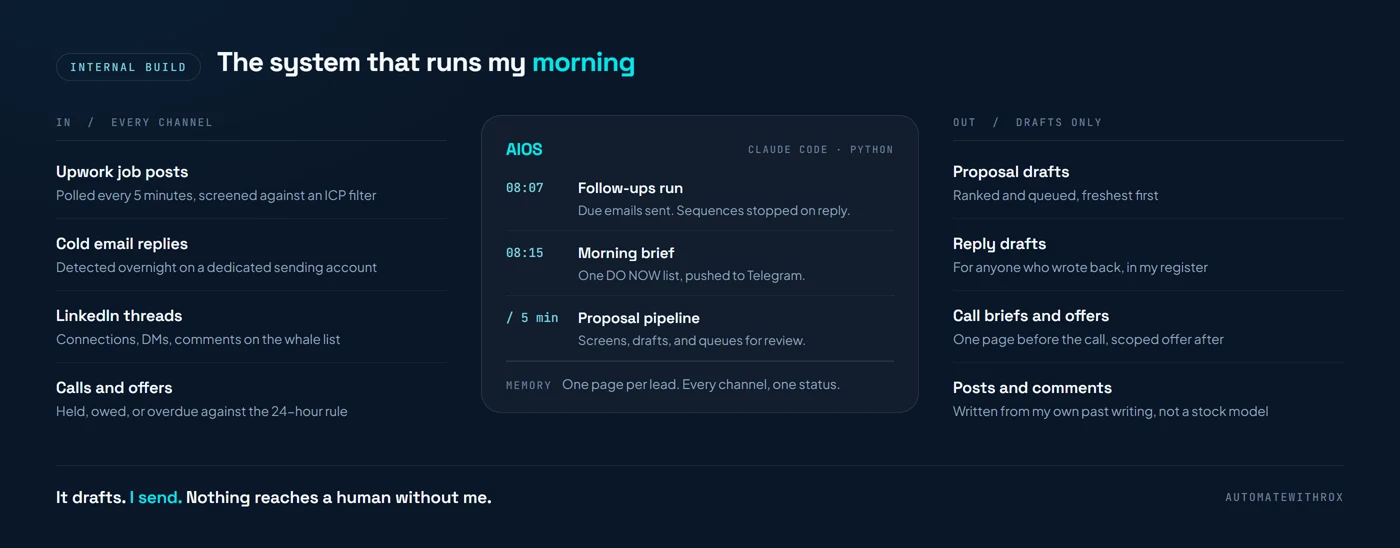
An operating system for the business itself. Three scheduled jobs, one memory, and a set of skills that draft the work:
- 08:07 every weekday. Follow-ups run. Emails that are due go out, replies are detected, and any sequence gets stopped the moment a human writes back
- 08:15 every weekday. One brief reads every channel and pushes a single DO NOW list to my phone: who I owe a reply, which call needs prep, which offer is overdue
- Every 5 minutes. New job posts are screened against an ICP filter, then drafted into proposals and queued for review
- One page per lead. Every conversation from every channel lands in the same place with a status, so nothing depends on remembering
- Drafting skills. Discovery-call briefs, scoped offers, reply drafts, LinkedIn posts and comments, all written from my own past work rather than a stock model
- Decay checks. The brief names what is rotting: stale drafts piling up, a reply written but never sent, a channel that has gone quiet at the source
Where the line sits
It drafts. I send. No message reaches a client, a lead, or a platform without a person approving it first. The system is allowed to prepare everything and decide nothing.
That rule is also what makes it honest to show. Every artifact it produces is one I read before it left.
Demonstration outcome
Demonstration disclosure: this is a portfolio build. The workflow behavior described here is not a measured client business result.
The morning decision is gone. The day arrives as a list, follow-up runs whether I remember it or not, and the failures that used to be silent now announce themselves before they cost a lead.
One more result worth naming. Turning the system on itself exposed a pipeline burning roughly 26 million tokens a day on work that plain code could do. Rewritten, it produces the same drafts for about one percent of the cost. That is the same audit I run on a client's stack, pointed at my own.
Practical guides
Plain checklists for lead follow-up and booking workflows.
A Pre-Launch Checklist For Your GoHighLevel Lead Follow-Up
How to test a lead-to-booked-call workflow with fake leads before it ever touches a real one, plus a worked hypothetical run and a plain checklist you can copy.
The One-Page Scope Test for a GoHighLevel Lead-to-Booked-Call Install
A practical checklist for coaches and consultants who want to define one lead-to-booked-call automation before paying anyone to build it, with a hypothetical worked example.
The Handoff Sheet: What a Person Needs When Your Booking Workflow Fails
A buyer guide for coaches and consultants on GoHighLevel. Learn which failures should go to a person, what the handoff must say, and what to ask a builder.